468x60


Showing posts with label unit 5. Show all posts

Casual Question Verb Endings +니?/+냐?


The verb forms you studied previously in this unit can also be used for making questions. However, in casual form the following is an alternative question style :

Verb Stem
Question Style
+니?
+ni?
Less blunt
+냐?
+nya?
More blunt

The +냐? (+nya?) ending is more blunt and tends to be used more by males and the less blunt +니? (+ni?) form is used more by females. The rule for constructing these forms is quite simple. Examples :


1)   Are you listening to music?


음악 듣니? 
eumak deudni?
    
음악 듣냐?
eumak deudnya?
     

2)   Are you going home?

집에 가니?
jibe gani?

집에 가냐?
jibe ganya?


3)   Are you having lunch?


점심 먹니?
jeomshim meogni?

점심 먹냐?
jeomshim meognya?


4)   Are you texting (on the mobile phone)?

문자 하니?
munja hani?

문자 하냐?
munja hanya?


Want a better view? Download this note :


Verb (Doing Words) and their Endings +아/어, +아/어요, +(으)세요


In unit three you have learned the different styles of speech used in Korean depending on the relationship between speakers. Here we will focus again on that three types : 1) casual form, 2) polite form, and 3) honorific form.


Verb stem
Style of Speech
+아/어
+ a/eo
Casual
+아/어요
+ a/eoyo
Polite
+(으)세요
+ (eu)seyo
Honorific


Verb endings are quite similar to the English present tense, as in ‘I study’ or ‘she studies’. However, it is also used to indicate an action that is going on at present, as in ‘I am studying at the moment’ (as well as ‘I am studying at Monash University this year’). See examples below.

Casual Form


1)   If the last vowel of the stem is ㅏ/ㅑ (a/ya) or ㅗ/ㅛ (o/yo)   :   +아 (+a)

 살    +    아    →    살아        (live/lives/is living, etc)
sar    +     a            sara

 가    +    아    →     가            (go/goes/ is going, etc)
 ga    +     a             ga

***가 (ga) already hasㅏ(a) and no final consonant, so you don’t need to add 아 


2)   If the last vowel is not ㅏ/ㅑ (a/ya) or ㅗ/ㅛ (o/yo)   :   +어 (+eo)

   먹     +     어    →     먹어          (eat/eats/is eating, etc)
meog    +     eo           meogeo

 읽       +     어    →     읽어          (read/reads/is reading, etc)
 irg      +     eo            irgeo

  쓰      +     어    →     써             (write/writes/is writing, etc)
 sseu    +    eo            sseo

***When the stem ends in the vowel ‘ㅡ’ (eu), the ‘ㅡ’ (eu) itself is dropped.


3)   If no final consonant, the vowels are usually combined into one syllable  :

 오      +     아    →      와              (come/comes/is coming, etc)
  o               a               wa

 주      +     어    →      줘              (give/gives/is giving, etc)
ju             eo             jwo


4)   If the stem ends in 하 (ha) : 하 (ha) → 해 (hae)

      하              →        해                  (do/does/am doing, etc.)
      ha                         hae

  공부하         →      공부해           (study/studies/am studying, etc.)
kongbuha             kongbuhae

이야기하       →      이야기해       (talk/talks/am talking, etc.)
 iyagiha                    iyagihae
 

This rule is useful when you look up unknown words in the dictionary. Don’t worry too much about having to remember these rules. The best way at this stage is to memorize both stem and ending together.


Polite Form

Polite form is constructed in the same way as casual form except that you add 요 (yo) at the end.

 살   +   아   →   살아   +   요   →   살아요             (live/lives/is living, etc)
sar   +    a            sara    +   yo          sarayo

    먹   +   어   →   먹어     +   요   →    먹어요       (eat/eats/is eating, etc)
meog +   eo       meogeo  +    yo       meogeoyo


Honorific Form

There are rules for forming honorific form depending on whether the verb stem ends in a consonant or vowel.

1)   If the verb stem ends in a vowel : +세요 (+seyo)

 가   +   세요   →   가세요                (go/goes/ is going, etc)
 ga   +   seyo           gaseyo

2)   If the verb stem ends in a consonant : +으세요 (+euseyo)

앉   +   으세요   →   앉으세요        (sit/sits/is sitting, etc)
anj  +   euseyo          anjeuseyo


If there’s any confusion, don’t hesitate to ask us.


Want a better view? Download this note : 


Make Your Own Gifts Here

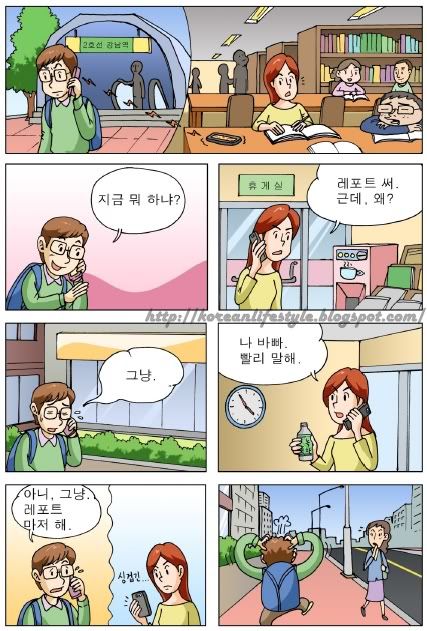
Situation Dialogue 1


Study the conversation below :


Romanisation and Translation

Minseo is at the library when she receives a call from Jihun.

지훈  :   지금 뭐 하냐?                                    What are you doing?
             Jigeum mwo hanya?

민서  :   리포트 써.                                          Write report.
             Repoteu sseo.
             근데, 왜?                                             But, why?
             Keunde, wae?

지훈  :   그냥.                                                   No reason.
             Keunyang.

민서  :   나 바빠.                                               I’m busy.
             Na bappa.
             빨리 말해.                                           Quickly say it.
             Bballi marhae.

지훈  :   아냐, 그냥.                                          No, I was just asking.
             Anya, keunyang.
             리포트 마저 해.                                   Finish the report.
             Repoteu majeohae.


Want a better view? Download this note :


Looking for gifts for birthday, wedding, anniversary etc?