468x60


Showing posts with label consonants. Show all posts

Consonant Assimilation


The nasal consonants are ㄴ and ㅁ. To keep pronunciation easy and flowing some consonants get changed before these two consonants as shown below :

1) Some p-based sounds become ‘m’:
    ㅂ, ㅍ becomes sound

2) Some t, s, ch, and h-based sounds become ‘n’:
    ㄷ, ㅌ, ㅅ, ㅆ, ㅈ, ㅊ, ㅎ becomes sound

3) k/g based sounds become ‘ng’, like in English singer (not sin-ger)
    ㄱ, ㅋ, ㄲ becomes sound

Examples :


Actual Spelling
Sound
Actual Pronounce
Sound
입니다
ip-ni-da
임니다
im-ni-da
있는데
iss-neun-de
인는데
in-neun-de
일학년
il-hak-nyeon
이랑년
i-lang-nyeon

ㄹ also has its own assimilation rules. If ㄹ and ㄴ come together, the ㄹ wins (don’t say the ㄴ at all). It means the n BECOMES an l. If ㄹ comes before an ‘i’ or ‘y’ sound the ㄹ sound is doubled. More of an ‘l’ sound than an ‘r’ sound.
ㄹ + ㄴ becomes double ㄹ (l) sound
ㄹ + (이, 야, 여, 유, etc.) becomes double ㄹ (l) sound

Examples :

Actual Spelling
Sound
Actual Pronounce
Sound
진리
jin-ri
질리
jil-ri
곤란
kon-lan
골란
kol-lan
팔년
pal-nyeon
팔련
pal-lyeon
서울역
seo-ul-yeok
서울력
seo-ul-lyeok

These changes are made to keep pronunciation economical.
Have you ever wondered how Koreans seem to be able to speak so fast? This is one of the reason.

Want a better view? Download this note :


Pronouncing Final Consonants


All the consonants except for ㄸ, ㅃ and ㅉ can be final consonants. However, there are only seven final consonant sounds when pronouncing individual syllables. These are called Batchim (받침) and have their own sound:

Consonant
Sound
Example
Pronounce
Meaning
k/g
극장
keug-jang
cinema
n
nun
eye; snow
t/d
듣기
teud-gi
listening
r/l
pal
foot
m
음악
eum-ak
music
p/b
pab
cooked rice; meal
ng
싱가포르
shing-ga-po-reu
Singapore


Other final consonants take on one of the above seven end consonant sounds:

Consonant
Sound
Example
Pronounce
Meaning
k ()
부엌
pu-eok
kitchen
k ()
깎다
kkak-da
cut down
t ()
ot
clothes
t ()
샀다
sat-da
bought
t ()
nat
daytime
t ()
kkot
flower
t ()
kkeut
end
t ()
히읗
hi-eut
name of  Korean letter ‘
p ()
ap
front


From this 2nd table, what I'm trying to say is :
~For example, we take 샀다 (sat-da) From what you've learned before, don't you think that it was supposed to pronounced as sas-da, but why I wrote sat-da instead? The reason is because, there are some Korean words that supposed to be pronounced like that. As soon as you learn more, you'll recognized more words. 

If you have any confusion, pls don't hesitate to ask me.


Want a better view? Download this note :


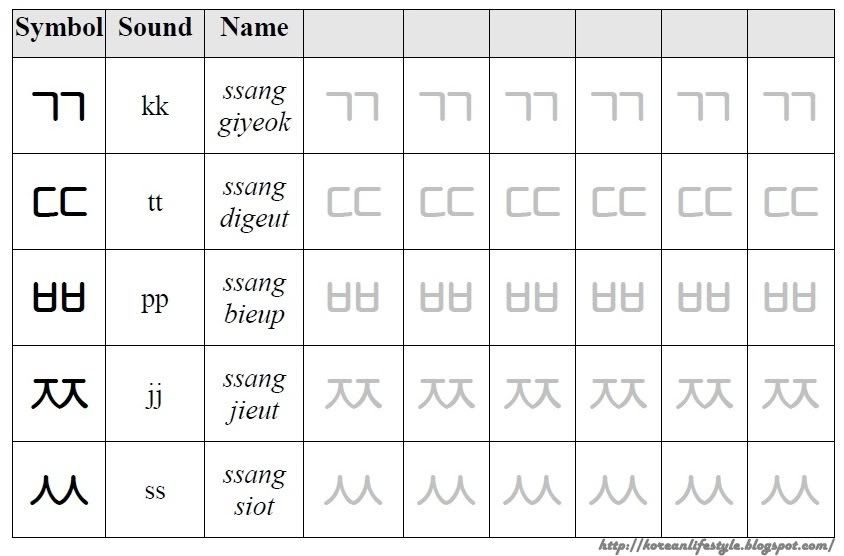
Tensed Consonants


For tensed consonants, we have :


Hangeul
Pronounce
Example
kk
as in sky
tt
as in stop
pp
as in spy
jj
similar to its easy
ss
as in essence


A tensed consonant such as ㄲ sounds like trying to pronounce two ㄱ at the same time. It requires more effort and you need to tense the muscles around your vocal chords.

Now practise writing these consonants:


Further examples :

Hangeul
Pronounce
Meaning
꼬리
kko-ri
tail
따라 하세요
tta-ra-ha-se-yo
repeat after me
바빠요
pa-ppa-yo
(I am) busy
짜요
jja-yo
(It is) salty
싸요
ssa-yo
(It is) cheap

Want a better view? Download this note :

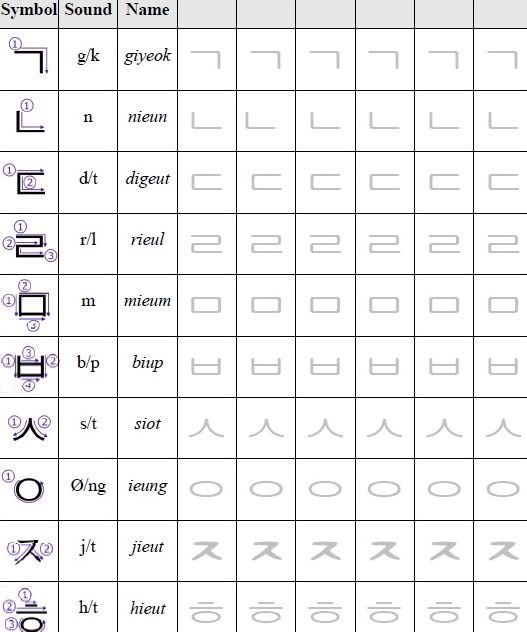
Basic Consonants


Basically, we have :

(1)        k/g (as in kid or game)
(2)        t/d (as in tiger or dog)
(3)        p/b (as in pig or bed)
(4)        ch/j (as in charming or jungle)
(5)        s (as in speech)
(6)        m (as in mother)
(7)        n (as in noise)
(8)        r/l (as in rain or lily)
(9)        h (as in high)
(10)      ng (as in ring) This sound only applies when ㅇ is the final consonant of a syllable.When the same symbol is used at the start of a syllable it has no sound, and acts as a dummy consonant for syllables that begin with a vowel.


***Note : According to the original Hunmin Jeongeum text :
  depicts the root of the tongue blocking the throat;
  depicts the outline of the tongue touching the upper palate;
  depicts the outline of the mouth;
  depicts the outline of the incisors (the teeth at the front);
  depicts the outline of the throat.

The other symbols were derived by adding strokes to the basic ones.


Practise writing the consonants, paying attention to the stroke order shown below.


Want a better view? Download this note :